
Apostille Near Me
Browse all guides+
By document

California Birth Certificate Apostille: How to Get One

By Frank MetayerUpdated September 17, 2026

A California birth certificate apostille fails for one reason more than any other: the copy in your hand is the wrong kind. California issues two versions of the same record, a Certified Authorized Copy and a Certified Informational Copy. Both are real, both are signed and sealed, and both carry the same facts. But the informational version is stamped "INFORMATIONAL, NOT A VALID DOCUMENT TO ESTABLISH IDENTITY," and that legend is exactly why the Secretary of State sends it back without an apostille. Only the authorized copy is accepted for an apostille. Order the right one at the start and most of the trouble disappears.

A birth certificate is a public vital record, which puts it on a different track from private documents like a bank letter or a diploma. You do not get it notarized. Instead you need a certified authorized copy that already carries the signature of the county official or the State Registrar who keeps the record, and the California Secretary of State apostilles that signature. Below is the California-specific path, start to finish: which copy to order and how to get one, why a notary never enters the picture, the step-by-step process, timing and validity, and where these apostilles usually go.

Key takeaways

  • Only a Certified Authorized Copy can be apostilled. The Certified Informational Copy — stamped "INFORMATIONAL, NOT A VALID DOCUMENT TO ESTABLISH IDENTITY" — is a real certified record but is rejected for apostille and international use.
  • Get the authorized copy from the county recorder or clerk of the county of birth, from California Department of Public Health (CDPH) Vital Records (the State Registrar), or through the state's official online vendor, VitalChek. If you don't have one, we can retrieve it for you.
  • No notary is involved. The Secretary of State apostilles the certificate because it already bears an official's signature; notarizing a photocopy of a vital record is the wrong path and gets packets rejected.
  • The California Secretary of State is the only office that issues the apostille — at its Sacramento main office and a Los Angeles regional office, with mail-in and in-person or expedited options (as of 2026; confirm current details).
  • An apostille itself never expires, but many receiving authorities want a certificate issued within the last 3–6 months — that's the recipient's rule, not California's.
  • An apostille works only for Hague Convention countries; many destinations also require a certified translation, and a non-member country needs embassy or consular legalization instead.

Authorized vs. informational: the copy that decides everything

This one detail matters more than anything else that follows. California law limits who can receive a Certified Authorized Copy: the registrant, a parent or legal guardian, a spouse or domestic partner, certain other family members, and a few others the statute lists. Everyone else is issued a Certified Informational Copy. Both are certified public records with the registrar's signature and seal, but only the authorized copy is accepted to prove identity or to obtain an apostille. The informational copy carries the legend "INFORMATIONAL, NOT A VALID DOCUMENT TO ESTABLISH IDENTITY," and that legend is what makes it ineligible.
Certified Authorized CopyCertified Informational Copy
Who can order itRegistrant, parent/guardian, spouse/partner, certain family, and others the law listsAnyone (members of the public)
Carries a legend?No legend"INFORMATIONAL, NOT A VALID DOCUMENT TO ESTABLISH IDENTITY"
Establishes identity?YesNo
Accepted for apostille / use abroad?YesNo — rejected
So before you order, confirm you qualify and ask specifically for the Certified Authorized Copy. Already have a certificate in a drawer? Check it for the informational legend. If the legend is there, it will not apostille no matter how new it is, and you'll need to order an authorized copy. Sorting this out before you order saves the wasted trip that first-timers make more than any other.

How to get a certified (authorized) California birth certificate

If you don't already hold an authorized copy, there are a few official ways to get one, and all of them lead to a valid apostille as long as the copy is a properly signed original:
  • County recorder or clerk of the county where the birth was registered — often the fastest, and some counties can issue a certified copy the same day in person.
  • CDPH Vital Records (California Department of Public Health), which serves as the State Registrar for the whole state — thorough but can run slower when demand is high.
  • VitalChek — the state's authorized online ordering vendor, if you prefer to order over the web.
  • Use a copy you already own — as long as it's a Certified Authorized Copy with a proper signature and seal (not laminated, not a photocopy, seal intact).
  • Have us retrieve it — if you can't get to the county office or don't qualify to order remotely, our document-retrieval service can obtain the certified copy and move straight into the apostille.
Whichever route you choose, the copy has to be a properly signed original. A laminated keepsake, a plain photocopy, or a copy with a broken or missing seal will not pass. Order early when you can: a certificate you don't yet have is the most common cause of a blown deadline.

Who can order an authorized copy

Eligibility drives the whole process, so it's worth knowing where you stand before you order. As of 2026, California Health & Safety Code generally allows a Certified Authorized Copy to be issued to (confirm current rules, as they can change):
  • The person named on the certificate (the registrant)
  • A parent or legal guardian
  • A spouse or registered domestic partner
  • A child, grandparent, grandchild, or sibling
  • A law-enforcement or government agency acting in an official capacity
  • An attorney representing the registrant (or the registrant's estate), or a party entitled to the record by a court order
Anyone not on that list can still obtain a Certified Informational Copy, but remember that version cannot be apostilled. If you're gathering a certificate for a relative's dual-citizenship or visa file, make sure the person ordering qualifies for the authorized copy. This is not legal advice; when eligibility is unclear, check the county office or CDPH before you order.

Why no notary belongs on a birth-certificate apostille

A birth certificate is a public vital record. Unlike a bank letter, an affidavit, or a diploma, it is never notarized on the apostille path. The signature the Secretary of State authenticates already belongs to a public official: the county recorder or clerk, or the State Registrar. In fact, California notaries are prohibited from certifying copies of vital records such as birth and death certificates, so that route is a dead end from the start. Bringing a notary into it can get the packet rejected, because notarizing a photocopy of a vital record creates a private notarized document instead of the certified public record the state expects.
This mix-up is common and it costs time: someone takes a birth certificate to a notary, has a photocopy certified, submits it, and watches it come back. The correct California path is short: get a Certified Authorized Copy from the county or CDPH, then send that copy to the Secretary of State. Notarizing a copy is how private documents reach an apostille; it is not how a vital record gets there.

How the California apostille process works, step by step
The sequence is short and the order matters. First, obtain a Certified Authorized Copy of the birth certificate from the county recorder or clerk of the county of birth, from CDPH Vital Records, or via VitalChek. Second, send that certified copy to the California Secretary of State for the apostille. Third, if your destination requires a translation, add a certified one in the order the receiving country specifies.
The Secretary of State is the only authority that issues the apostille, working them at its main office in Sacramento and a Los Angeles regional office, usually with both mail-in and in-person or expedited options. Because processing times shift with how you file and how busy the office is, check the Secretary of State's current processing dates rather than assuming a fixed turnaround.
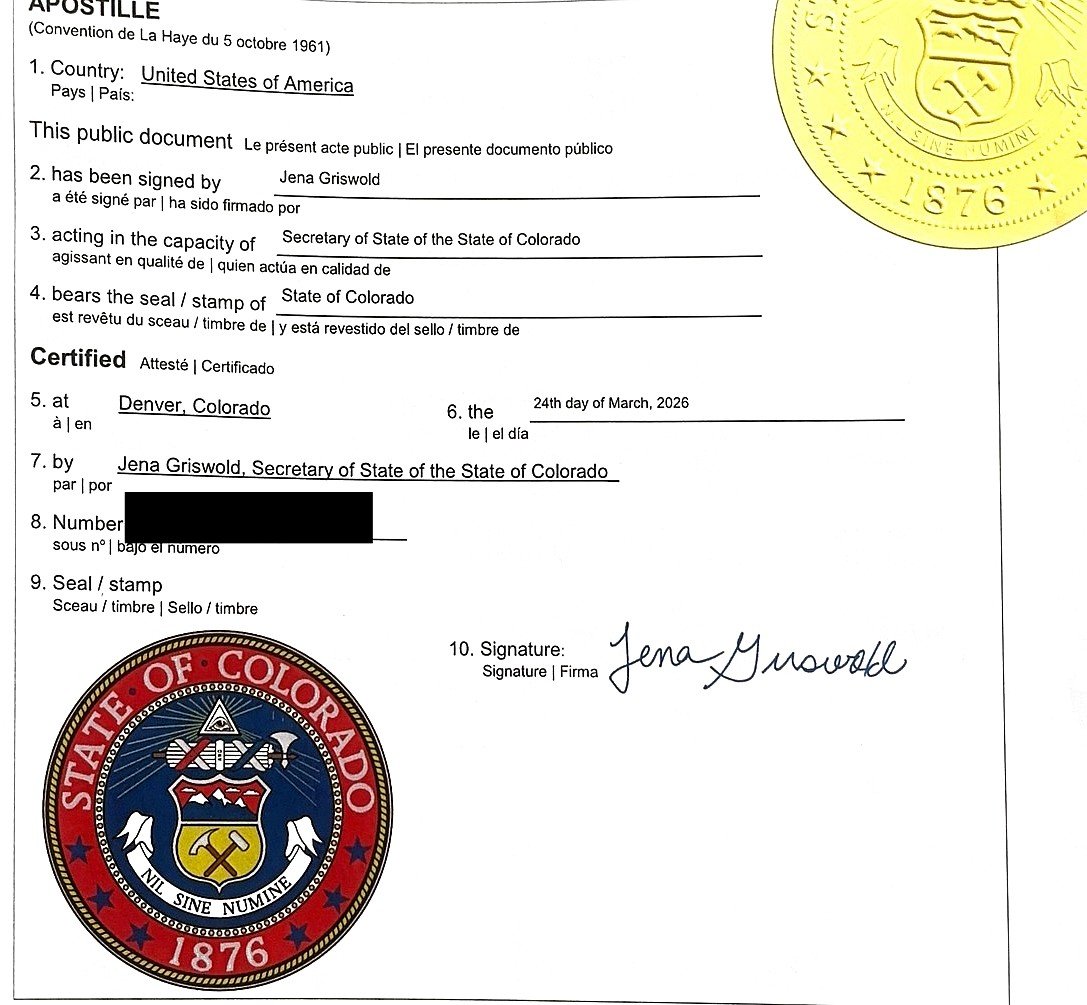
A redacted sample of an apostille certificate attached to a U.S. vital record
What the finished product looks like: an apostille certificate attached to the vital record (sample shown with the serial number redacted).
We don't publish government fees or fixed turnaround times, because they change with how you file and how fast you need the document (verify current fees and timelines for 2026). What protects the job is accuracy: a Certified Authorized Copy, sent to the right state authority, finished to match what the receiving country asked for. Those Sacramento and Los Angeles offices are the state's, not ours; we route these documents to them for clients across California and the rest of the country. We're a San Diego company, rated 5.0 stars across 132 Google reviews, BBB-accredited, and experienced with California Secretary of State apostille processing.

Does the certificate need to be recent? Timing and validity

An apostille itself has no expiration date; once the Secretary of State attaches it, it doesn't lapse. What does expire, in practice, is the receiving side's patience with an old certificate. Many consulates, universities, and foreign agencies ask for a birth certificate issued within the last 3–6 months, and some dual-citizenship processes are stricter still. That limit comes from the receiving authority, not from California, so the safe move is to order a fresh Certified Authorized Copy specifically for this filing rather than apostilling one from years ago.
A note on large counties: some, such as Los Angeles, have their own in-person, ID, or ordering requirements for vital records. If you're ordering from a big county, confirm its current process first. When you're unsure how recent the certificate must be, ask the receiving authority in writing before anyone begins; a wrong guess here means starting over.

Where these apostilles go — dual citizenship, translation, and non-Hague countries

Most California birth-certificate apostilles are headed somewhere predictable. Dual citizenship is the big one (an Italian, Irish, or Mexican claim traced through a parent or grandparent), followed by residence and student visas, marriage abroad, adoption files, and enrolling a child in a foreign school. In each case the foreign office wants assurance the U.S. record is genuine, and for a country in the Hague Apostille Convention (the treaty that lets member countries accept one another's public documents with a single apostille instead of embassy legalization) the apostille supplies it. Countries in the Convention, including Spain, Italy, Mexico, most of the EU, and much of Latin America, accept a Certified Authorized Copy once it carries an apostille.
A translation often travels with it. When the destination works in another language, you'll usually need a certified translation of the birth certificate, and the receiving country sets the order: frequently the certificate is apostilled first and the packet translated afterward, though some consulates want the translation apostilled too. And a country outside the Convention changes the plan entirely. There, an apostille alone won't satisfy the consulate, and the certificate has to go through embassy or consular legalization instead. Membership shifts as new countries join, so confirm where your destination stands in 2026 before you file.

Apostille your California birth certificate without the guesswork

Tell us who the certificate is for, the destination country, and your deadline. We'll confirm you have the Certified Authorized Copy (or retrieve one for you), route it to the California Secretary of State, and add a certified translation if you need one — with a flat, all-in quote before any work begins, no hidden fees, and no obligation.

Frequently asked questions

Can I apostille an informational copy of a California birth certificate?+

No. California issues two certified versions — the Certified Authorized Copy and the Certified Informational Copy. Both are real certified records, but the informational one carries the legend "INFORMATIONAL, NOT A VALID DOCUMENT TO ESTABLISH IDENTITY" and is rejected for apostille and international use. You need the Certified Authorized Copy.

How do I get a Certified Authorized Copy of my California birth certificate?+

Order it from the county recorder/clerk of the county of birth (often same-day in person), from CDPH Vital Records (the State Registrar), or through VitalChek, the state's authorized online vendor. You must qualify to receive an authorized copy. If you can't get one yourself, we can retrieve it for you and move straight into the apostille.

Can I use a VitalChek copy for an apostille?+

Yes, as long as what you order is the Certified Authorized Copy (not the informational version) and it arrives as a properly signed, sealed original. VitalChek is an official ordering channel; the copy still has to be the authorized one to be apostilled.

Do I need to notarize a California birth certificate before the apostille?+

No. A birth certificate is a public vital record, so it is not notarized. The certified copy already carries an official's signature, and the Secretary of State apostilles that signature. Notarizing a photocopy of a vital record creates a private document and is a common reason these requests are rejected.

Should I order the copy from the county or from CDPH?+

Either works. A Certified Authorized Copy from the county recorder/clerk of the county of birth or from CDPH Vital Records can be apostilled, because both carry an authorized official's signature. A county office is often faster in person; CDPH serves the whole state. Confirm current processing times before you rely on one.

Does my California birth certificate need to be recently issued, or does it expire?+

The apostille itself never expires. But many consulates, universities, and foreign agencies want a birth certificate issued within the last 3–6 months, and some dual-citizenship processes are stricter. That's the recipient's rule, not California's — so it's usually safest to order a fresh authorized copy for the filing. Confirm the exact requirement with the receiving authority.

Can you retrieve my California birth certificate if I don't have it?+

Yes. If you don't hold a Certified Authorized Copy, our document-retrieval service can obtain one from the issuing office and then route it to the California Secretary of State for the apostille — handled as a single job.

Which office issues the apostille for a California birth certificate?+

The California Secretary of State issues the apostille, processing requests at its Sacramento main office and a Los Angeles regional office, with mail-in and in-person/expedited options. We are a San Diego–based company experienced with California Secretary of State apostille processing — those state offices are not ours.

How long does it take to apostille a California birth certificate?+

It depends on how you file and how busy the Secretary of State is, and California offers expedited handling for tighter deadlines. Official processing dates change, so we confirm the current timeline for your filing method before you commit to a deadline rather than promising a fixed number of days.

Do I need a certified translation of my California birth certificate?+

Often, yes. Many consulates and foreign authorities require a certified translation into the destination country's language — sometimes attached before the apostille, sometimes after. The receiving country sets the order. We coordinate a certified translation in the correct sequence for your destination.

How much does it cost to apostille a California birth certificate?+

It depends on the document, the issuing authority, and how fast you need it. You get a flat, all-in quote before any work begins — with no hidden fees, and no obligation.